How might an autonomous driving interface communicate fatigue and handover risk before it becomes an emergency?
HMI · Experience Design · Product Design
BEATROLHow can AI-driven systems enhance safety in autonomous driving?
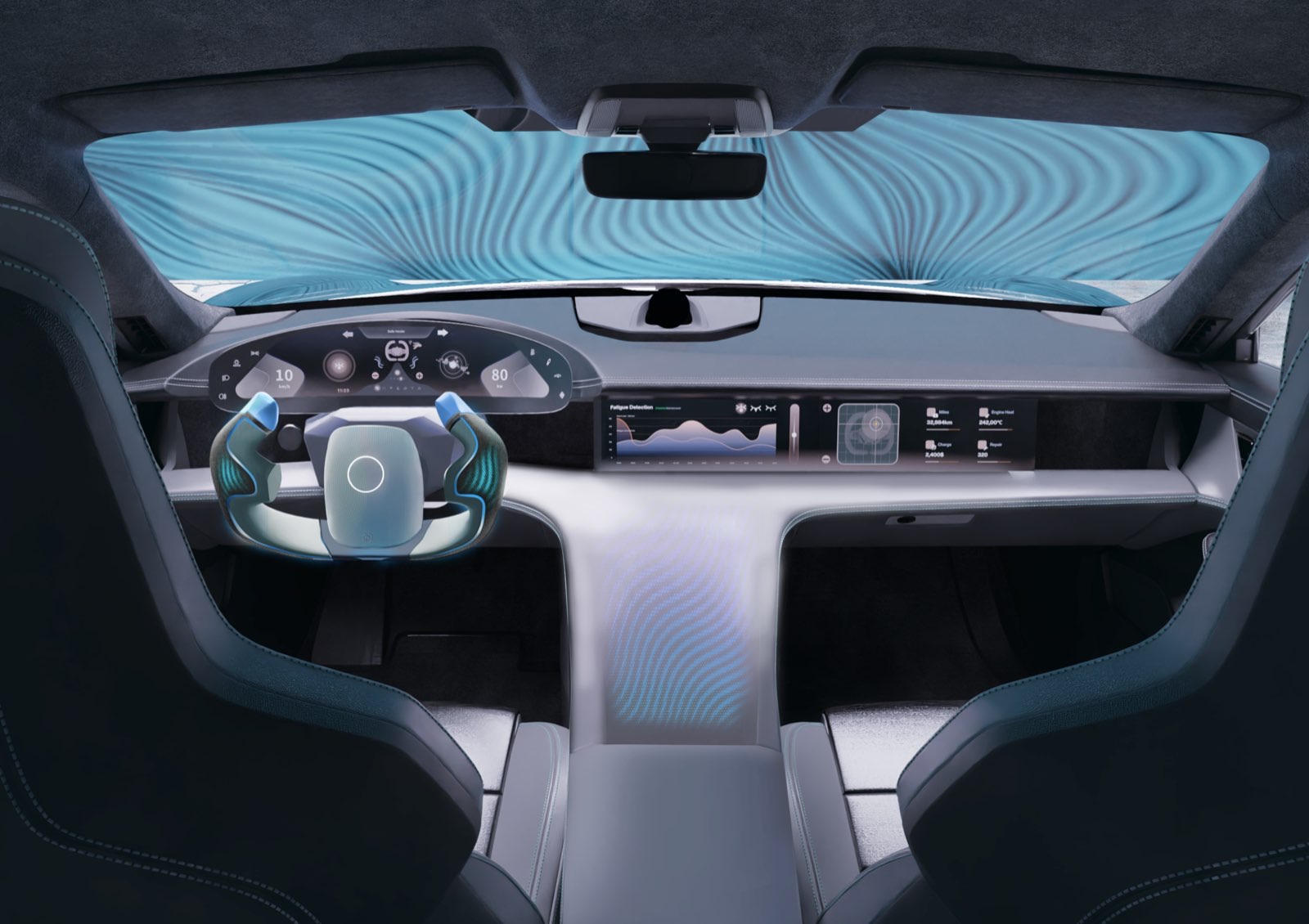
A speculative L4 cockpit that treats driver fatigue as a design surface. not a single signal to wake someone up, but a graded handover where the vehicle takes more authority as the driver's attention degrades.
Impact
A speculative L4 cockpit that re-frames driver fatigue as a design surface. not a signal to wake the driver up, but a sequence for handing power back and forth between human and vehicle as attention degrades. The fatigue case is one slice of a larger question about how authority should move between humans and machines as their relative competence shifts.
Role
Timeline
Team
The Challenge
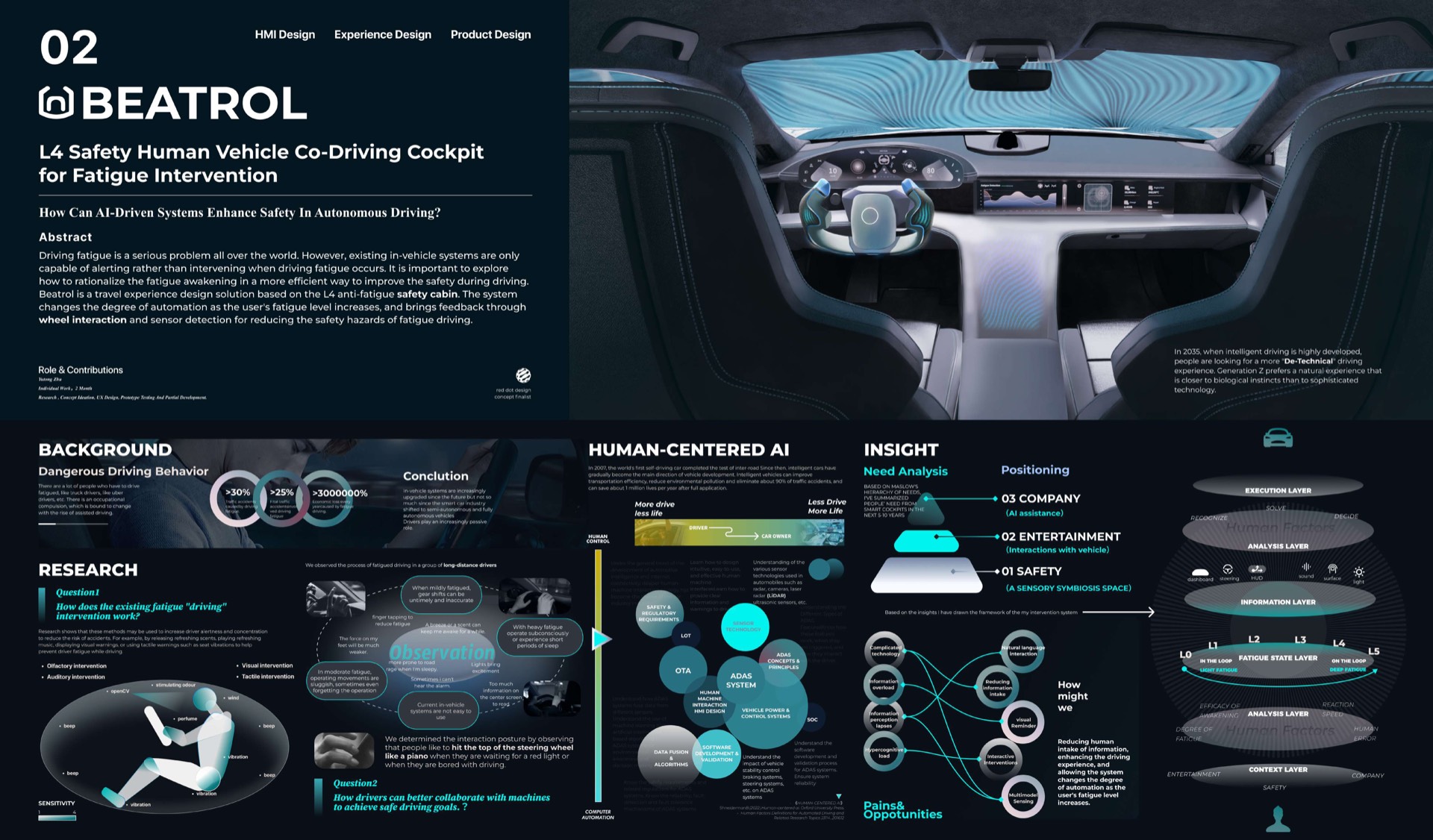
Fatigue-related crashes account for around 30% of road accidents and a quarter of fatalities, with millions of incidents per year. The in-vehicle systems being shipped today can detect fatigue and beep. they cannot intervene. As autonomous driving moves toward L4, the design question stops being 'how do we wake a driver up?' and becomes 'how do we hand power back and forth between human and vehicle as the driver's attention degrades?'
Design logic
Questions & Key Decisions
What should a tactile control surface do when the driver is between active control and automation trust?
01Key decisionDesign fatigue as a gradual stateBinary alerts make the system feel reactive; drivers need time to understand why control is being...
- Problem
- Binary alerts make the system feel reactive; drivers need time to understand why control is being requested.
- Decision
- I represented fatigue through progressive visual states, soft warnings, and a tactile steering-wheel interaction.
- Why it worked
- A gradual model supports trust because the car explains risk before it demands action.
- Outcome
- The interface reframed handover as a shared negotiation between driver and system.
02Key decisionUse the wheel as the communication pointA screen-only warning can be missed in a semi-autonomous cockpit, especially when attention is already...
- Problem
- A screen-only warning can be missed in a semi-autonomous cockpit, especially when attention is already degraded.
- Decision
- I moved part of the feedback into the steering wheel as a physical, glance-free cue.
- Why it worked
- The wheel is already the handover object, so it is the most direct place to signal readiness and urgency.
- Outcome
- The prototype made the service scenario more believable than a pure dashboard concept.
Research & Discovery
Two questions framed the inquiry:
- How do existing fatigue-driving interventions work. olfactory, auditory, visual, tactile. and where do they fail?
- How can drivers and machines collaborate to reach a shared safety goal, instead of one yelling at the other?
The literature converges on multimodality and on intervention curves keyed to fatigue level. The Karolinska Sleepiness Scale (KSS) anchors the measurement; the gap is in tying KSS bands to graded automation handovers.
Design Strategy
Three design commitments anchor the build:
- A fatigue state graph as the spine. Awake → Mild fatigue → Deep fatigue maps to intervention layers, not single triggers.
- Sensors as a stack, not a single source. EEG, EDA, ECG, eye tracking, and a forward-facing CV camera feed a fused fatigue estimate.
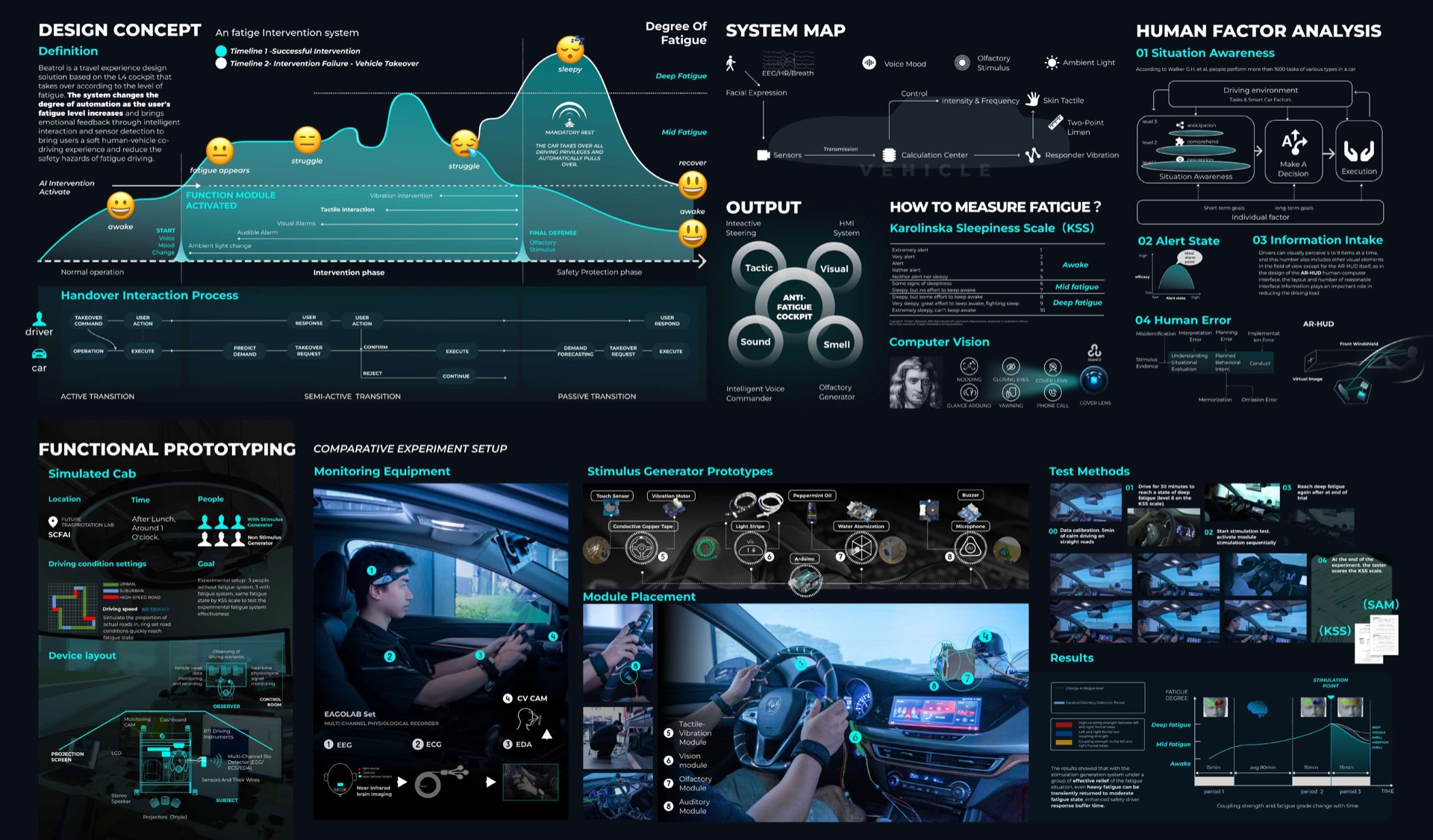
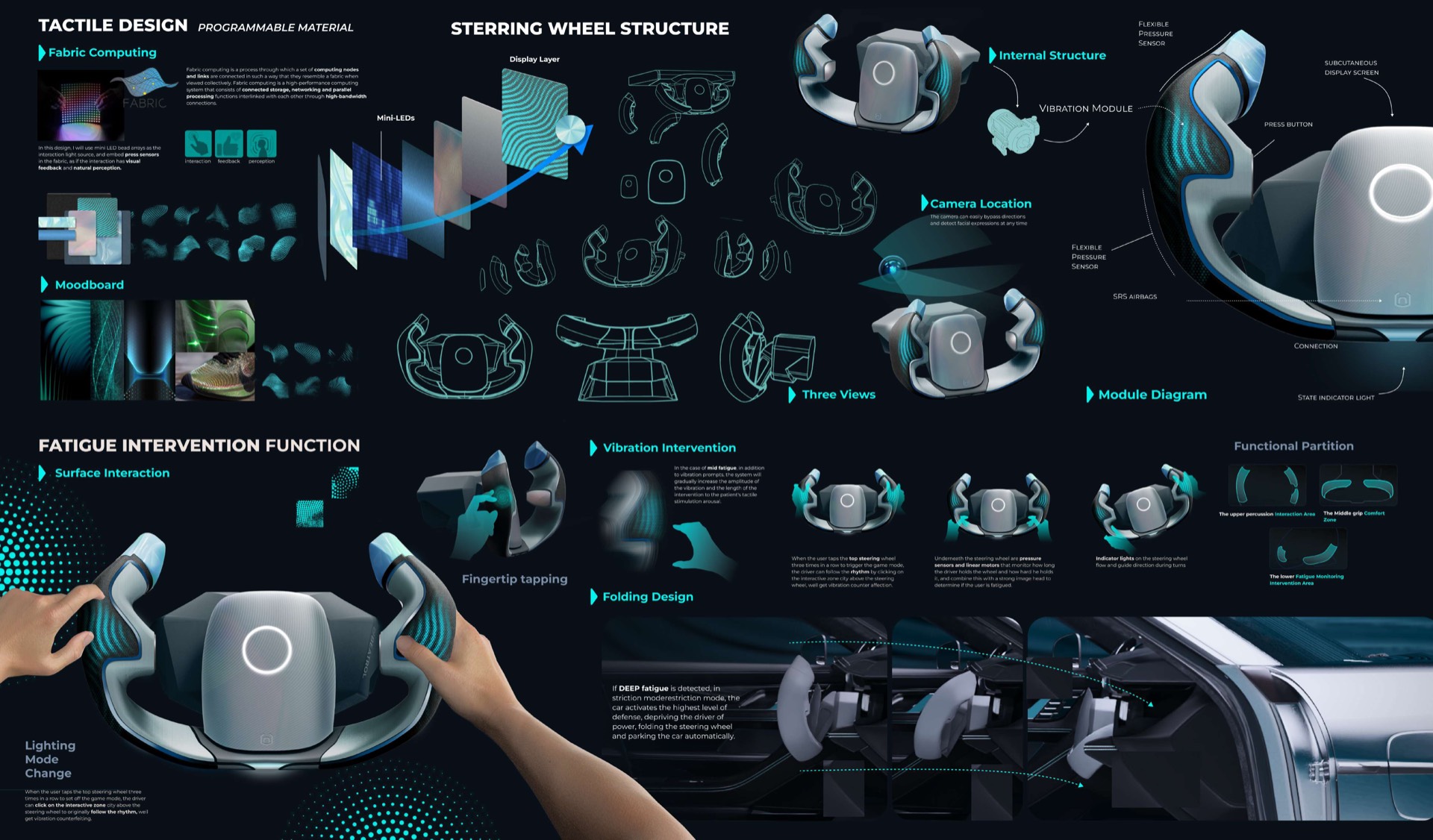
- Handover as a designed sequence. Active → semi-active → passive transition. the system steadily takes more control as the driver's fatigue band rises, ending in vehicle-led parking when 'deep fatigue' is detected.
Implementation & Pipeline
Physical: a tactile steering wheel with programmable fabric (a Mini-LED display layer + flexible pressure sensors + vibration modules + camera location) that folds into a docking position when the system fully takes over.
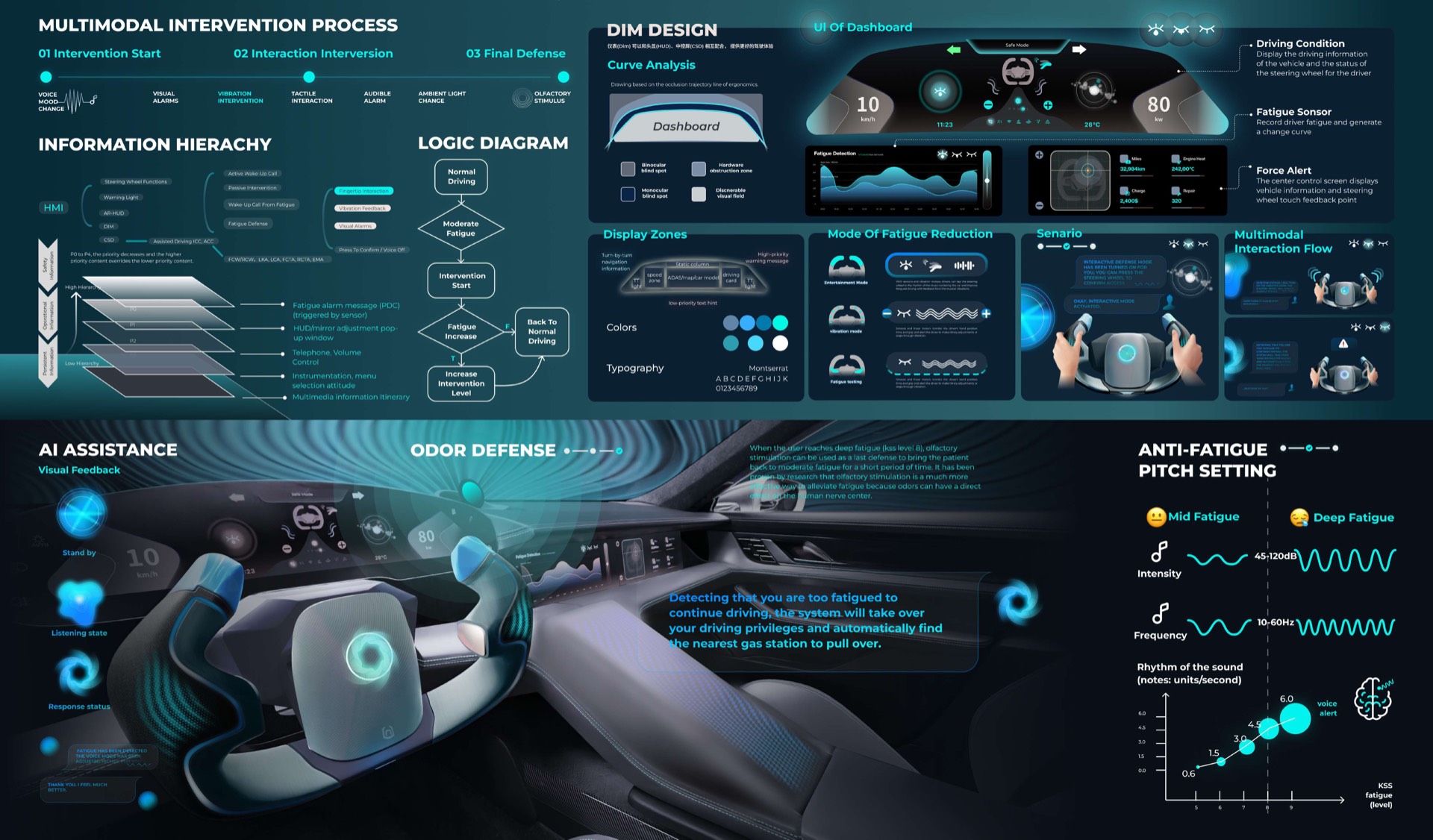
Digital: DIM dashboard with anti-fatigue pitch settings (mid fatigue 45 to 120 dB · deep fatigue 10 to 60 Hz), AI assistance with stand-by, listening, and response visual feedback, and a multimodal intervention flow.
Tested in a simulated cab with one driver across six lab sessions. SAM (subjective) and KSS (physiological) measures collected at each stimulus.
Results & Impact
Three design outputs the project carries:
- A fatigue-graded intervention framework. KSS bands as design surfaces.
- A tactile-first steering wheel with a foldable handover state.
- An anti-fatigue DIM dashboard with multimodal sensory layers (audio, vibration, light, scent).
Submitted to industrial design competitions in 2023; the design language was framed as 'L4 sensory symbiosis space', not 'driver-monitoring product'.
Lessons Learned
Two carry-forwards:
- Designing the handover, not the alarm. The hardest design problem wasn't detecting fatigue. sensors do that. it was choreographing the 30-second window where the system is taking over and the driver still feels like an agent, not a passenger.
- Sensors are vocabulary, not data. EEG, EDA, eye-tracking each speak a different language about attention. The job was translating between them and surfacing only the parts the driver needed to feel.
What's Next
Take the handover-as-choreography frame into other co-driving moments. lane-keeping under low confidence, urban-merge negotiations, valet handoff. The fatigue case is one slice of a larger question about how authority should move between humans and machines as their relative competence shifts.
Continue exploring