How might a plant become a participant in an interface without being reduced to a sensor?
Interaction Design
BotanictrumCan you transfer the pulse from plants?
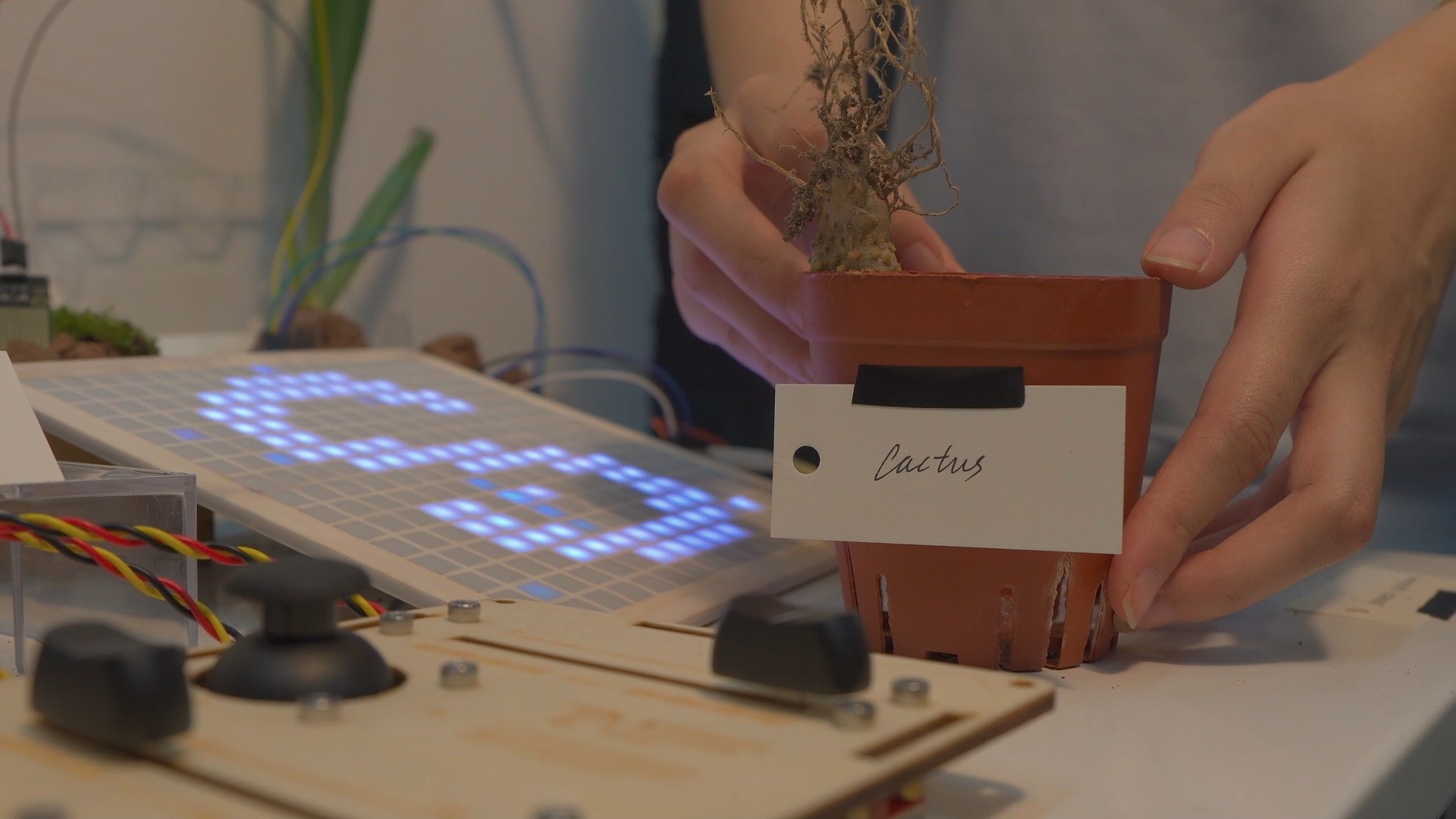
Combining mechanical parts with soil to extract abstract information from plants and present them visually.
Impact
An interaction prototype exploring plants as signal-bearing interfaces through sensing, light, and speculative feedback.
Role
Timeline
Team
The Challenge
Plant interfaces are often presented as decorative smart objects. I wanted to ask a more specific question: what would it mean to treat a plant as a living participant in an information system?
Design logic
Questions & Key Decisions
How can slow biological signals become legible to humans without pretending they are immediate data?
01Key decisionDesign for translation, not controlA dashboard would make the plant feel like a machine to monitor.
- Problem
- A dashboard would make the plant feel like a machine to monitor.
- Decision
- I used ambient feedback and suggestive visual states rather than command-style controls.
- Why it worked
- The project is about co-presence with a living system, so the interaction needed to stay soft and interpretive.
- Outcome
- The prototype keeps the plant's ambiguity while still making change perceptible.
02Key decisionRespect plant timeHuman interfaces expect fast feedback, but plant responses are slow and contextual.
- Problem
- Human interfaces expect fast feedback, but plant responses are slow and contextual.
- Decision
- I designed the feedback rhythm around gradual change instead of instant reaction.
- Why it worked
- A slower rhythm makes the system feel more honest to the material.
- Outcome
- The work becomes a stronger speculative interaction study rather than a novelty sensor demo.
Research & Discovery
The research focused on the mismatch between human time and plant time. Plants respond slowly and indirectly, so the interface needed to translate subtle changes without pretending the plant behaves like a device.
Design Strategy
I designed the work as an interpretive layer rather than a control panel. The interface should reveal patterns, not command the plant.
Implementation & Pipeline
The prototype uses a small sensing and visual feedback setup to create a responsive installation language.
Results & Impact
The project frames botanic interaction as a design problem of translation: how to make slow, living signals perceptible without over-instrumenting them.
Lessons Learned
The more the interface tried to explain, the less alive the system felt. The strongest moments were suggestive and ambient.
What's Next
A future version could test longer-term sensing and compare how different viewers interpret the same plant signals.
Continue exploring