How might an archive feel searchable and cinematic at the same time?
UI UX
LUNACYWhat role has the moon played in human culture and history?
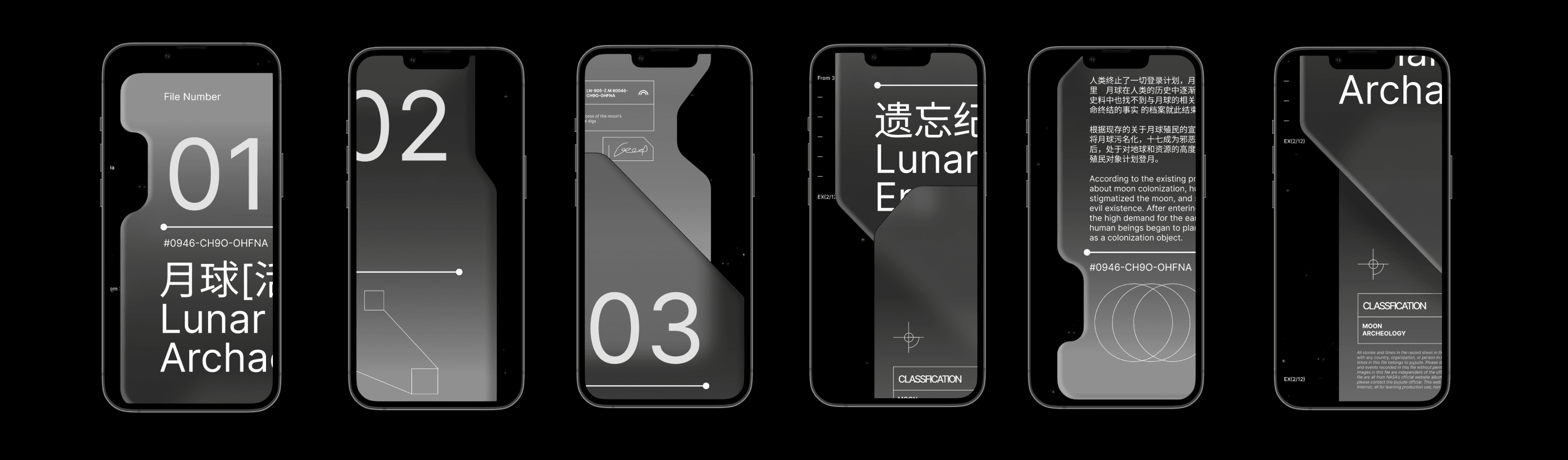
A pseudo-archive from the future, dramatizing the narrative that the moon, once a living entity, was rendered lifeless by the march of science.
Impact
A speculative web and motion archive that treats lunar mythology, image culture, and digital memory as a browsing system.
Role
Timeline
Team
The Challenge
The project began with a problem of archive experience. Lunar references are scattered across science, folklore, cinema, and visual culture, but browsing them often feels like searching a database rather than entering a world.
Design logic
Questions & Key Decisions
How can lunar cultural material keep its ambiguity while still becoming a usable interface?
01Key decisionBalance index and atmosphereA pure gallery felt too loose, while a database view removed the emotional quality of the material.
- Problem
- A pure gallery felt too loose, while a database view removed the emotional quality of the material.
- Decision
- I used an archive structure but softened it with motion, image rhythm, and dark spatial pacing.
- Why it worked
- The moon is both scientific object and cultural symbol, so the interface needed both clarity and mystery.
- Outcome
- The project communicates a stronger point of view than a standard visual collection.
02Key decisionUse cinematic sequencing as navigationUsers needed a way to move through references without reading a long explanation first.
- Problem
- Users needed a way to move through references without reading a long explanation first.
- Decision
- I treated transitions and image order as part of the storytelling system.
- Why it worked
- Sequence can guide attention before the user understands the full archive logic.
- Outcome
- The experience feels closer to an exploratory cultural essay than a static index.
Research & Discovery
I studied how moon imagery carries different meanings: measurement, madness, romance, navigation, ritual, and science. The tension was how to hold those meanings together without turning the site into a moodboard.
Design Strategy
I framed LUNACY as an archive with atmosphere. The interface needed enough structure for browsing, but enough ambiguity to feel like entering a lunar field.
Implementation & Pipeline
The work combines web layout, motion fragments, and image sequencing. Each screen balances index-like clarity with cinematic pacing.
Results & Impact
The outcome is a visual archive concept that demonstrates how a cultural collection can feel navigable without losing its mythic quality.
Lessons Learned
Archives need hierarchy, but speculative archives also need drift. The useful design tension is between orientation and wonder.
What's Next
A stronger next version would add source metadata, interactive filtering, and a clearer reading path for long-form research.
Continue exploring