How might invisible cognitive state become a useful coaching signal without reducing the player to a score?
Innovation Product Design · UX · HCI
Synco-EHow will brain-computer interfaces shape our brains in the future?
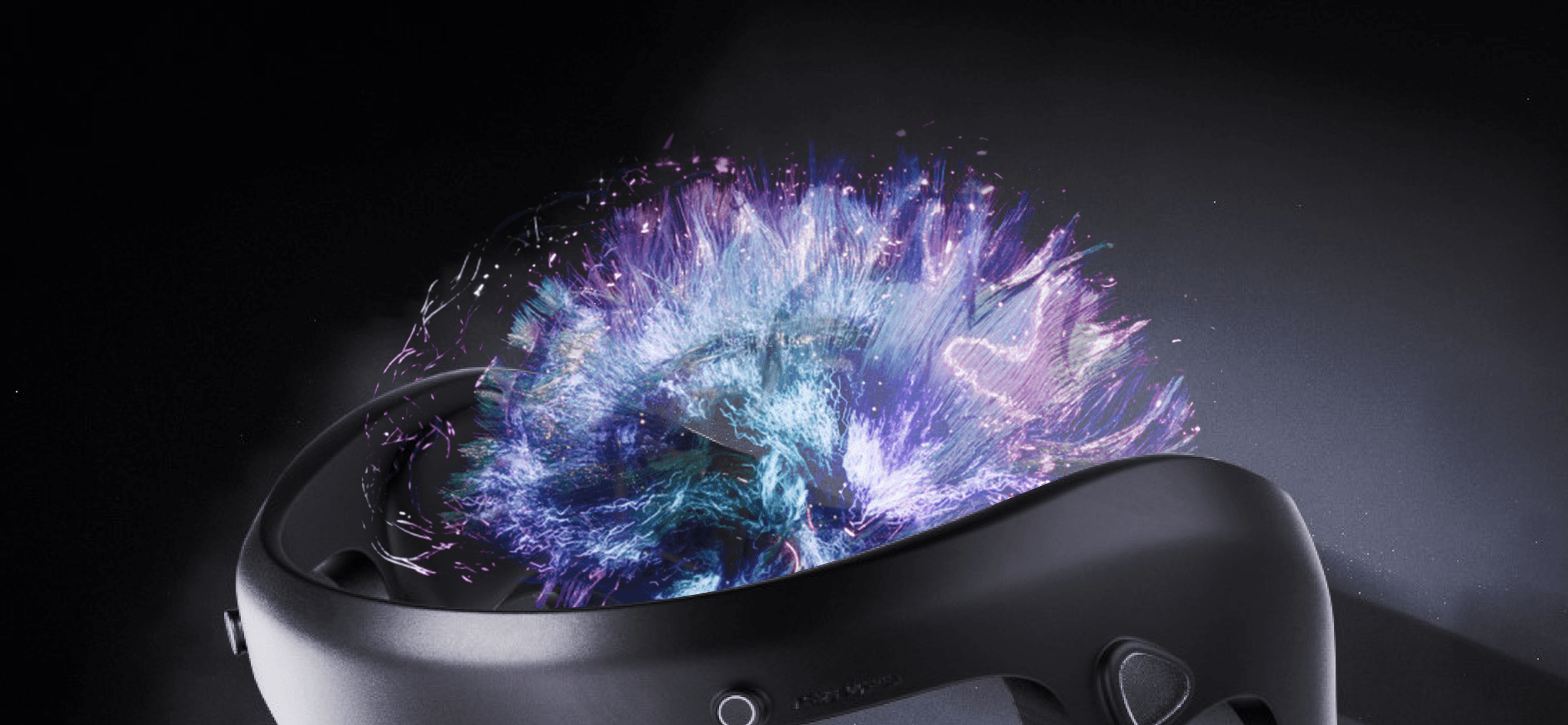
A speculative BCI device for pro-esports training. Designed to make the cognitive layer. the part traditional training treats as invisible. visible to coach and player in real time.
Impact
A speculative BCI device that asks whether the next generation of competitive players should be measured by their EEG response curves the way runners are measured by their heart-rate zones. Designed to make mental fortitude. the layer esports training treats as invisible. visible to coaches and players in real time.
Role
Timeline
Team
The Challenge
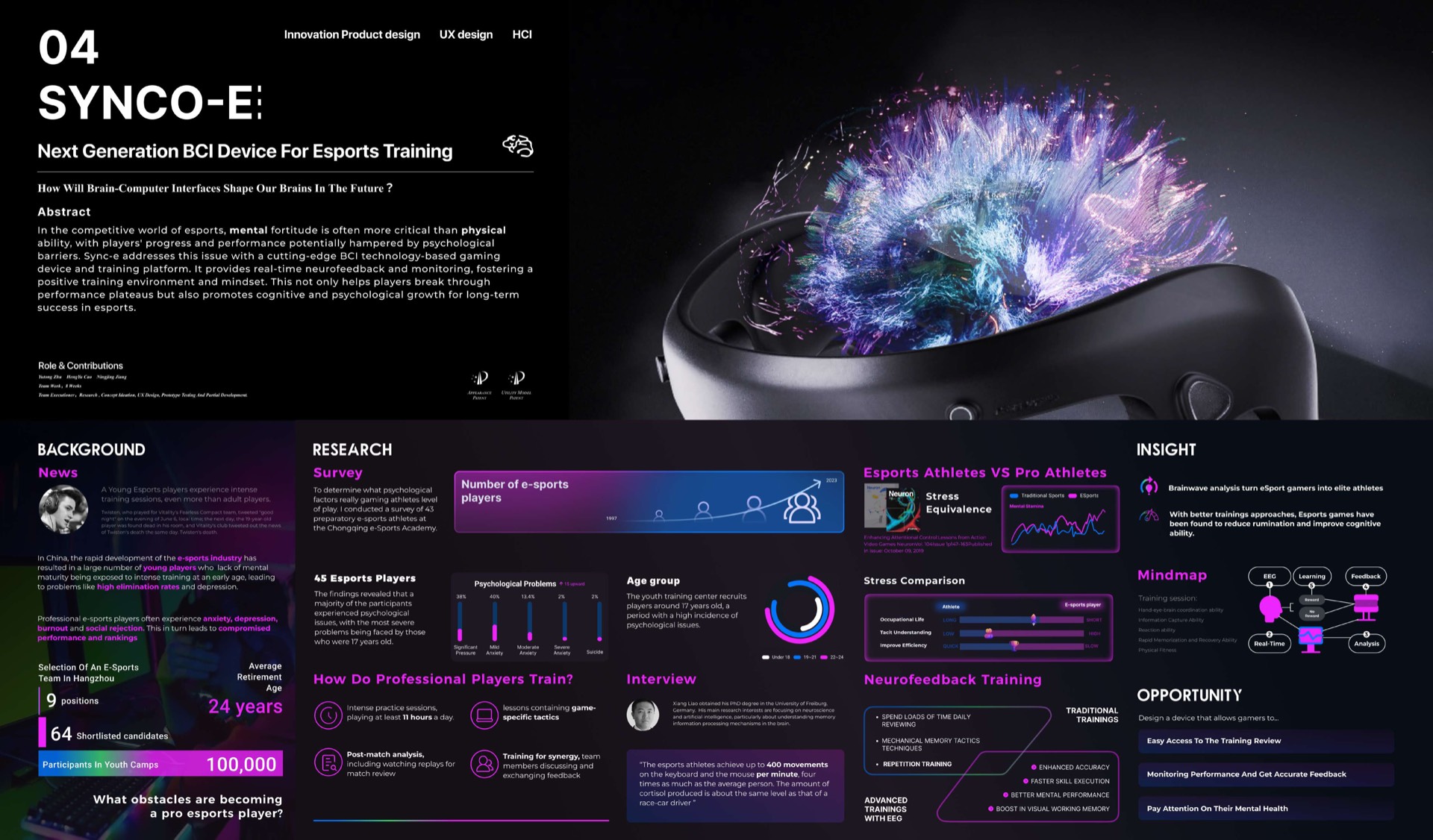
China's pro-esports pipeline is expanding faster than its mental-health infrastructure. Players retire at 24. The same cortisol load as a race-car driver, sustained for hours daily, with no recognised pathway for psychological recovery. Existing training maps reps and reaction time, but says nothing about cognitive fatigue, rumination, or the mental ceilings that limit a player's ability to break through performance plateaus.
Design logic
Questions & Key Decisions
How can BCI feedback be shown during esports training without distracting from performance?
01Key decisionTranslate brain data into coaching languageRaw BCI signals are meaningful to researchers, but not actionable for players or coaches in a training...
- Problem
- Raw BCI signals are meaningful to researchers, but not actionable for players or coaches in a training session.
- Decision
- I designed the interface around states, thresholds, and session patterns rather than raw neurological graphs.
- Why it worked
- Coaches need to identify moments of fatigue, focus, or overload and connect them to training decisions.
- Outcome
- The product story shifted from device novelty to a usable training companion.
02Key decisionKeep feedback peripheral during playA dashboard that asks for too much attention can harm the very performance it tries to improve.
- Problem
- A dashboard that asks for too much attention can harm the very performance it tries to improve.
- Decision
- I separated live peripheral indicators from deeper post-session analysis.
- Why it worked
- The player receives enough feedback to stay aware, while the coach can inspect richer patterns after the session.
- Outcome
- The prototype balances real-time awareness with reviewable performance evidence.
Research & Discovery
45-player survey across light-vs-severe psychological pressure, age group, and stress comparison. Coach interviews at the Hangzhou A1 academy.
Key insight from one coach: 'Esports athletes hit up to 400 movements on the keyboard and mouse per minute. four times the general population. The cortisol output is comparable to a race-car driver.' The same insight made the inverse possible: brainwave training has documented effects on rumination and cognitive recovery.
Design Strategy
Three design commitments:
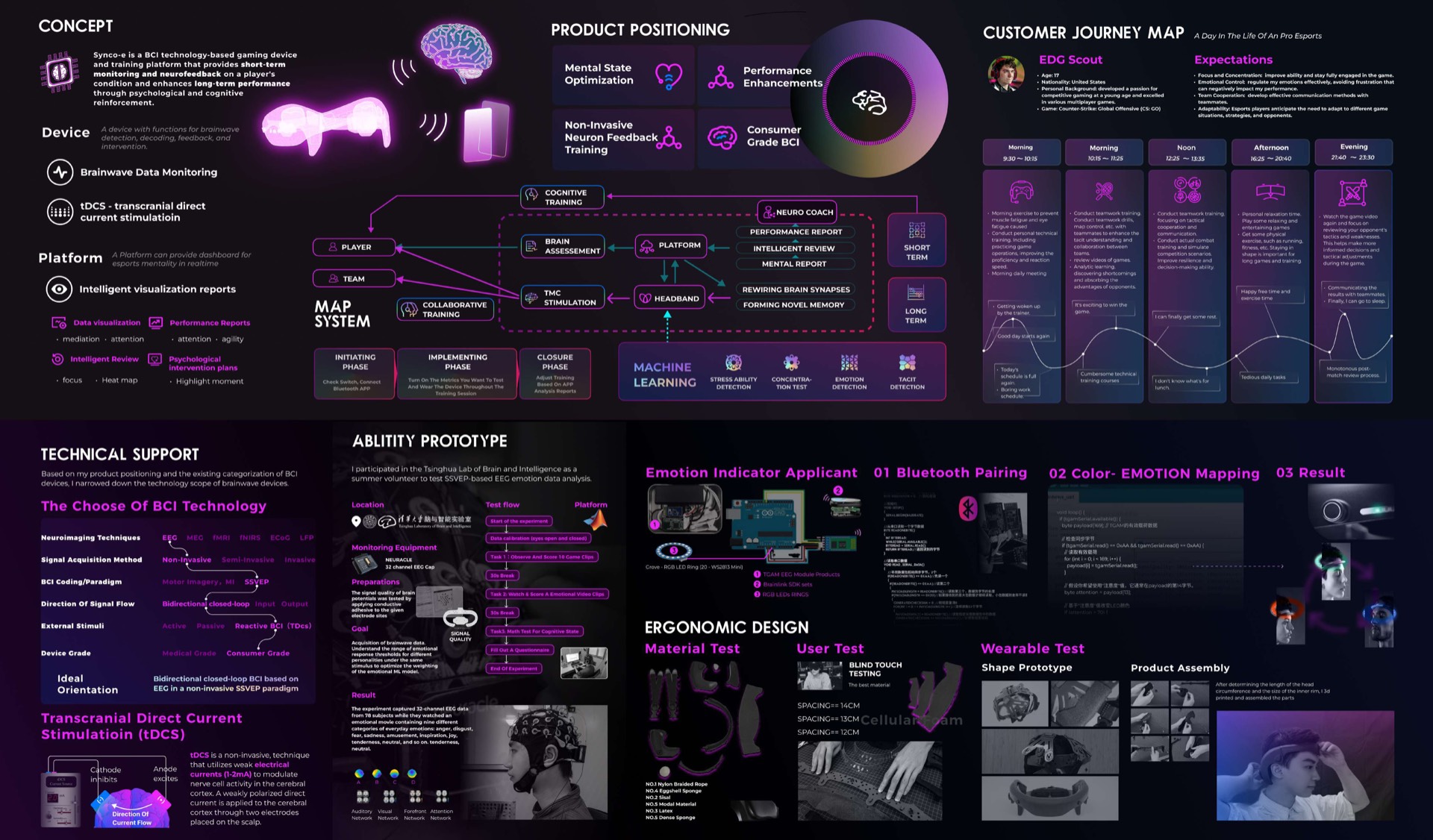
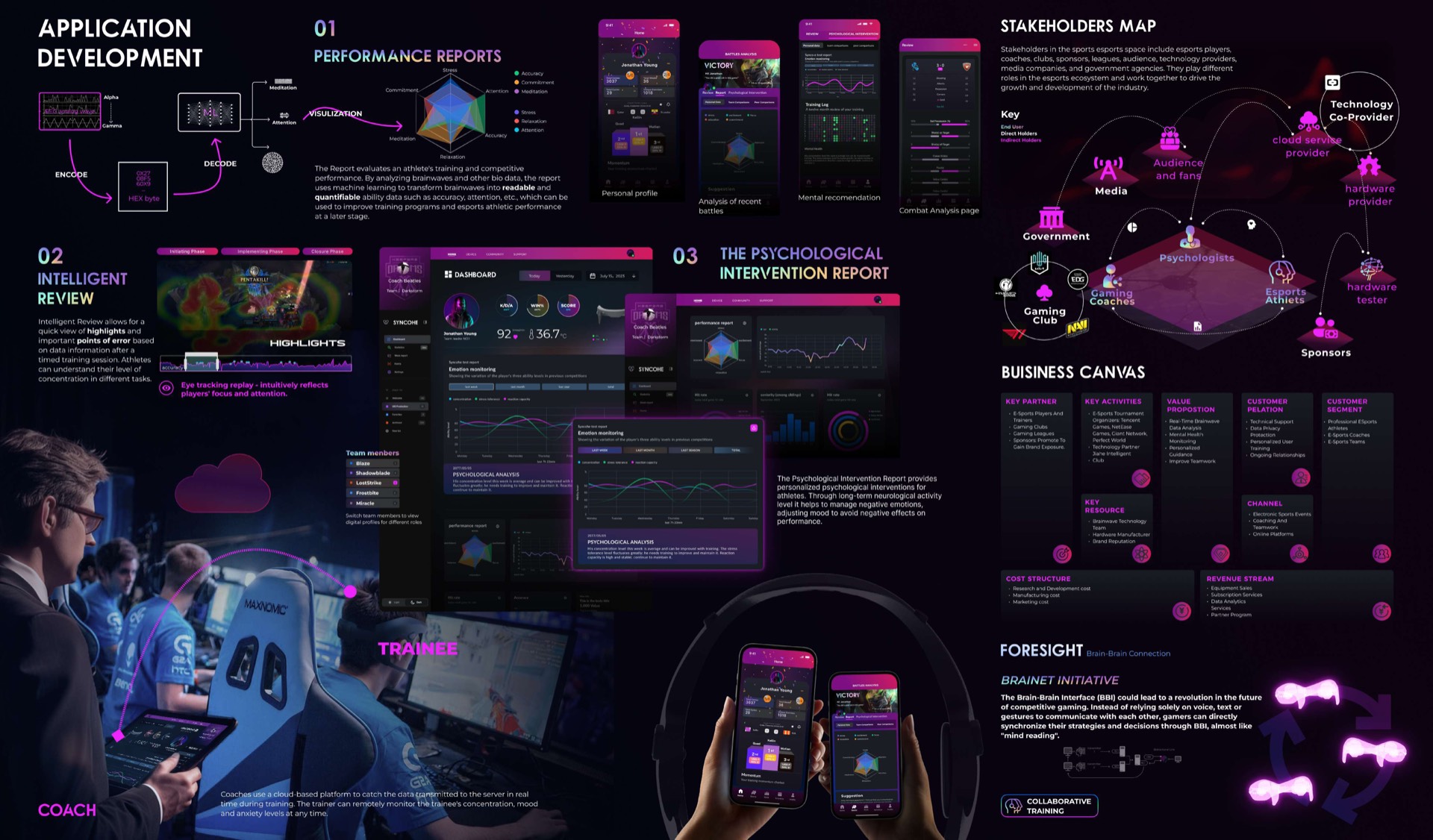
- Make mental training visible. EEG + PPG + EDA + IR sensors feed a real-time cognitive dashboard for player and coach.
- Design for the coach as much as the player. The neurofeedback loop only closes if the coach can read it during a match, not in a post-mortem PDF.
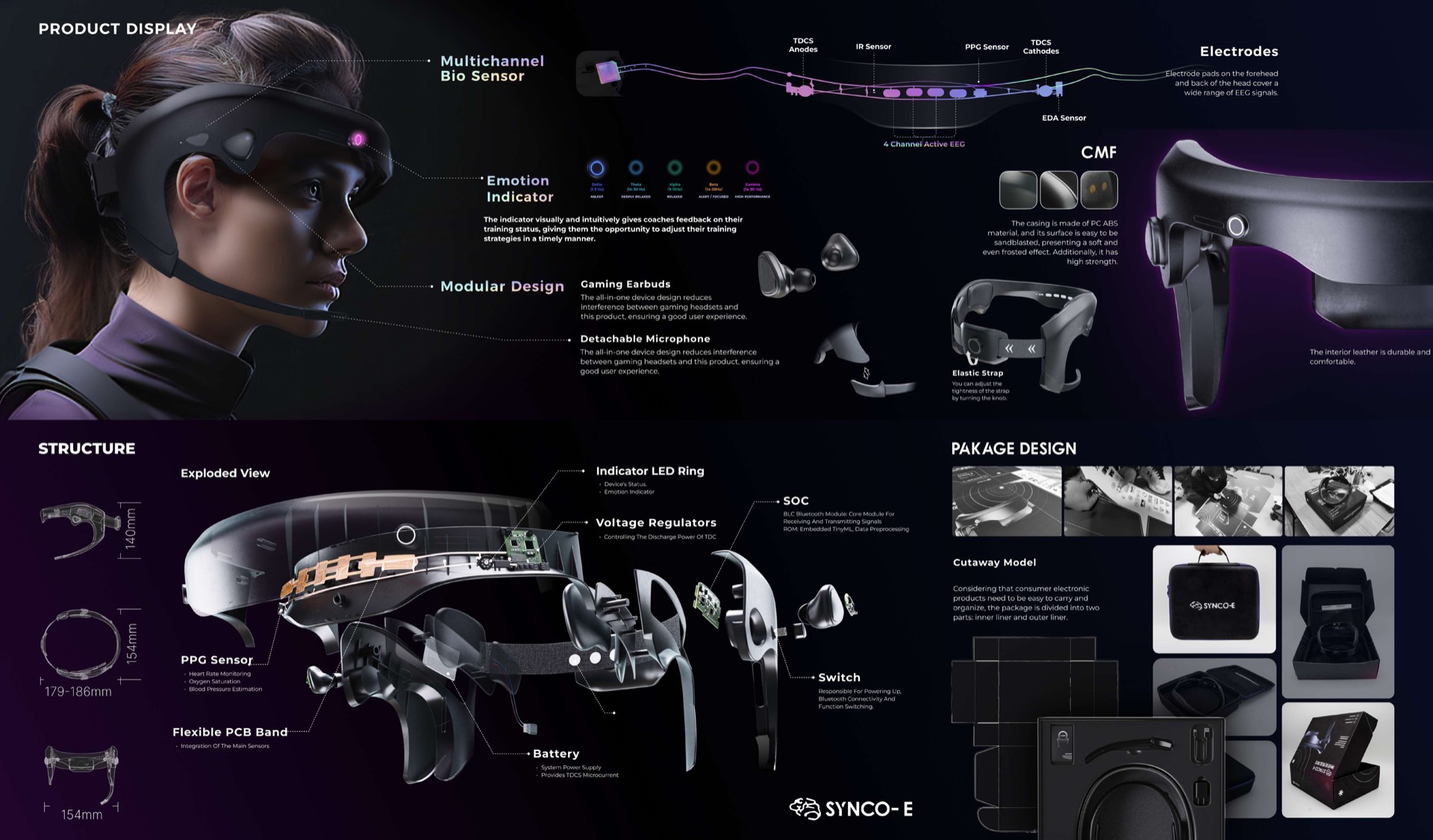
- Modular, not monolithic. Bio-sensor band + detachable microphone + gaming earbuds + emotion-indicator LED ring. each component has a separate failure mode and a separate price point.
Implementation & Pipeline
Hardware: multichannel bio-sensor headset with 4-channel active EEG (TDCS anodes and cathodes), PPG, EDA, and an IR sensor. Modular gaming earbuds, detachable microphone, flexible PCB band, indicator LED ring for coach-facing emotion state. CMF in PC ABS with sandblasted finish. Three head-size variants (140 mm, 154 mm, and 179 to 186 mm).
Digital: training-review platform pairing EEG traces with match replays. Comparative metrics chart 'traditional training' (mechanical memory + repetition) against 'advanced training with EEG' (enhanced accuracy, faster skill execution, better mental performance, boosted visual working memory).
Cutaway packaging model: easy carry plus organise on the go.
Results & Impact
Two design outputs:
- An EEG training device positioned for esports coaches and players, not generic 'brain training' consumers.
- A neurofeedback training framework that pairs match data with cognitive state for shared coach-player review.
Selected for the 27th Sichuan Fine Arts Institute Graduation Showcase (2024).
Lessons Learned
Three carry-forwards:
- Mental health needs an interface, not just a campaign. Esports already has rich performance data; what was missing was a way for the cognitive layer to enter the conversation.
- Two users, one device. A wearable that has to live on a player's head and on a coach's screen simultaneously is a different design problem than a consumer fitness tracker.
- Speculative product, real measurement. Even if today's BCI fidelity is more aspirational than shipping-grade, the framework. pair every match with a cognitive-state trace. is real and adoptable now with cheaper sensors.
What's Next
The framework generalises: any high-cognitive-load profession with a coach in the loop (chess, surgery training, music performance) could ride the same neurofeedback-plus-replay structure. The harder open question is what privacy looks like when a player's cognitive state is owned by their team.
Continue exploring