How might climate risk be experienced as a living signal rather than a distant data visualisation?
Interaction Design · Information Visualization · Storytelling
Wildfire-WhispersHow do humans coexist with extreme weather?
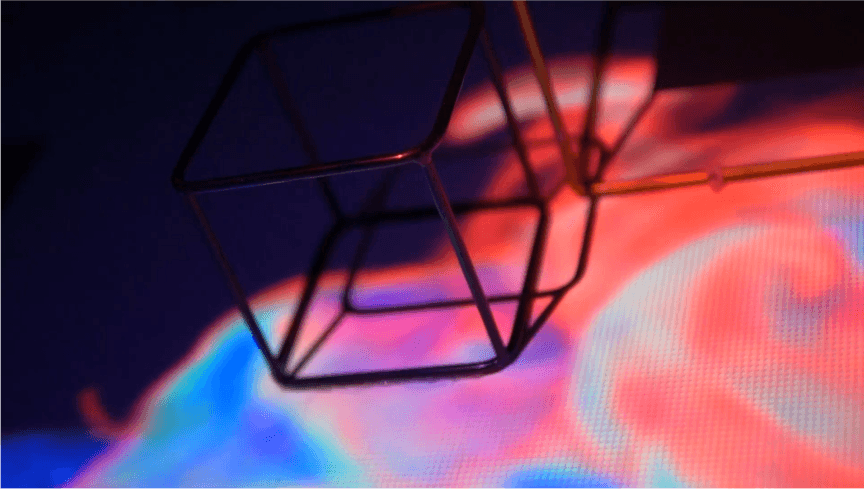
A 3m×2m geometric installation paired with a satellite-data poster series. Real-time gesture recognition turns five years of wildfire records into something a body can feel.
Impact
An immersive installation that turns five years of satellite wildfire data into something a body can feel. Gesture-driven projections plus a starburst-tree poster series invite a visitor to encounter climate intensity as a sensory event, not a chart.
Role
Timeline
Team
The Challenge
Wildfire awareness usually arrives as bar charts and dashboards. and gets scrolled past. As an undergraduate designer interested in how environmental data changes behaviour, the design question became: can the same data be felt rather than read, without trivialising the disaster, and without losing data integrity?
Design logic
Questions & Key Decisions
What interaction language can make a speculative environmental interface feel fragile, embodied, and urgent?
01Key decisionTurn wildfire data into a sensory encounterCharts can explain fire risk, but they rarely make the viewer feel the instability of an ecosystem...
- Problem
- Charts can explain fire risk, but they rarely make the viewer feel the instability of an ecosystem under stress.
- Decision
- I translated the topic into an interactive installation with responsive visuals, sound, and gesture-driven behaviour.
- Why it worked
- Embodied feedback creates a more immediate relationship between human action and environmental change.
- Outcome
- The work becomes an affective climate interface rather than a conventional awareness poster.
02Key decisionUse fragility as the interaction ruleA polished, stable interface would undercut the subject of volatility and ecological loss.
- Problem
- A polished, stable interface would undercut the subject of volatility and ecological loss.
- Decision
- I designed the visual system to shift, flicker, and respond as if it were unstable.
- Why it worked
- The behaviour lets the installation communicate risk through motion and atmosphere, not explanation.
- Outcome
- The final piece gives viewers a clearer emotional entry point into a complex climate issue.
Research & Discovery
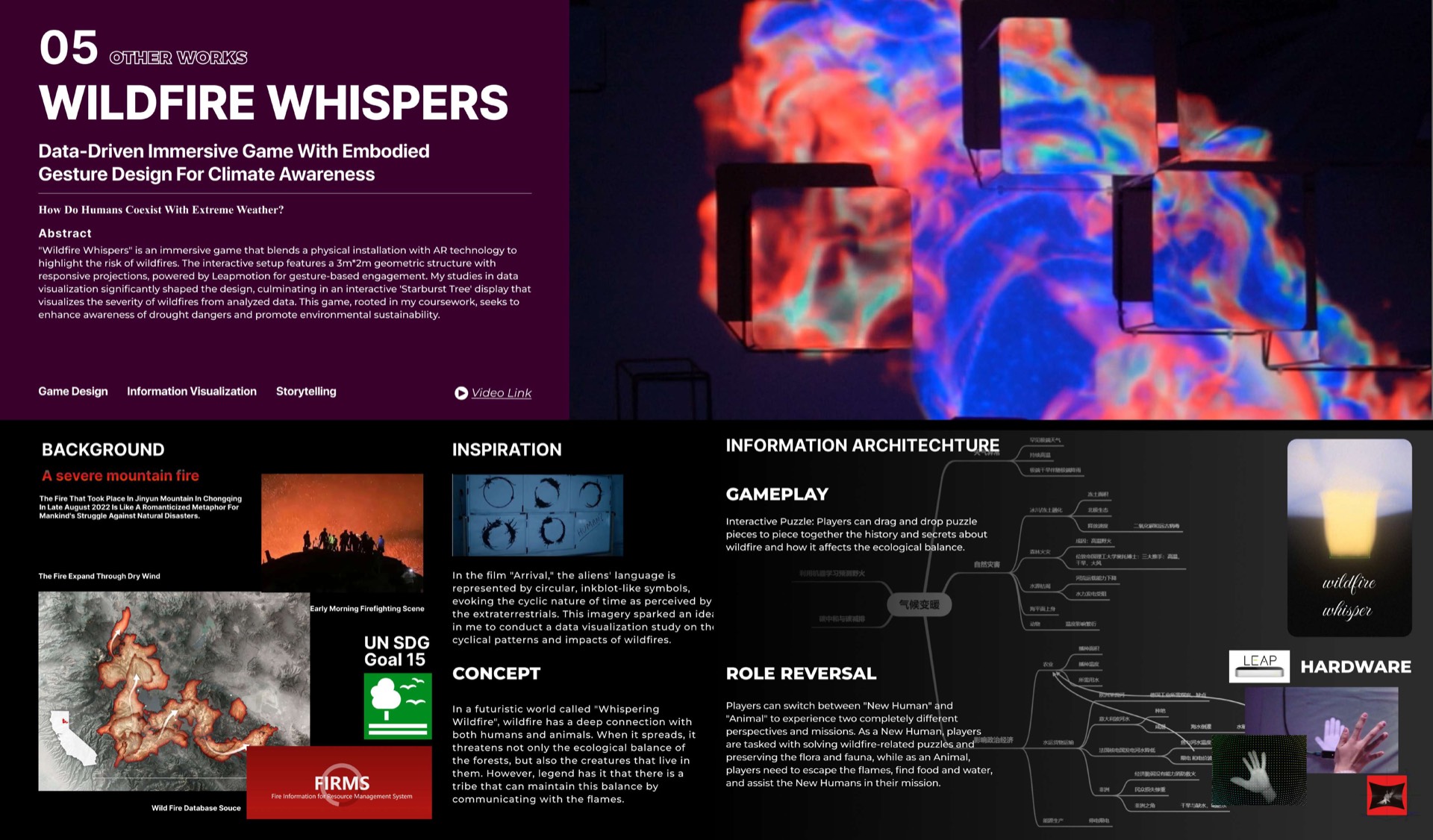
Inspiration drawn from Arrival. the alien language as circular, ink-blot symbols evoking the cyclic nature of time. That visual primitive translated cleanly to wildfire data: each fire has a start, an expansion arc, and a fade.
Source data: global satellite wildfire records, 2017 to 2021 (FIRMS). The work uses both the data itself and a fictional frame ('In a futuristic world called Whispering Wildfire, wildfire has a deep connection with both humans and animals…') drawn through the project, mapped to UN SDG Goal 15 (Life on Land).
Design Strategy
Three design commitments:
- Two parts, one logic. Part 1. a real-time installation with audio-visual mapping driven by gesture recognition. Part 2. a data-visualisation poster series turning satellite wildfire data into 'starburst tree' compositions.
- Body-first input. Leap Motion plus Unreal Engine for gesture-driven interaction; the visitor's hand becomes the cursor onto the data.
- Role reversal as game design. In the interactive puzzle layer, players switch between 'New Human' and 'Animal' to experience two perspectives. as a New Human, you solve wildfire-related puzzles and protect the flora and fauna; as an Animal, you escape the flames and find food.
Implementation & Pipeline
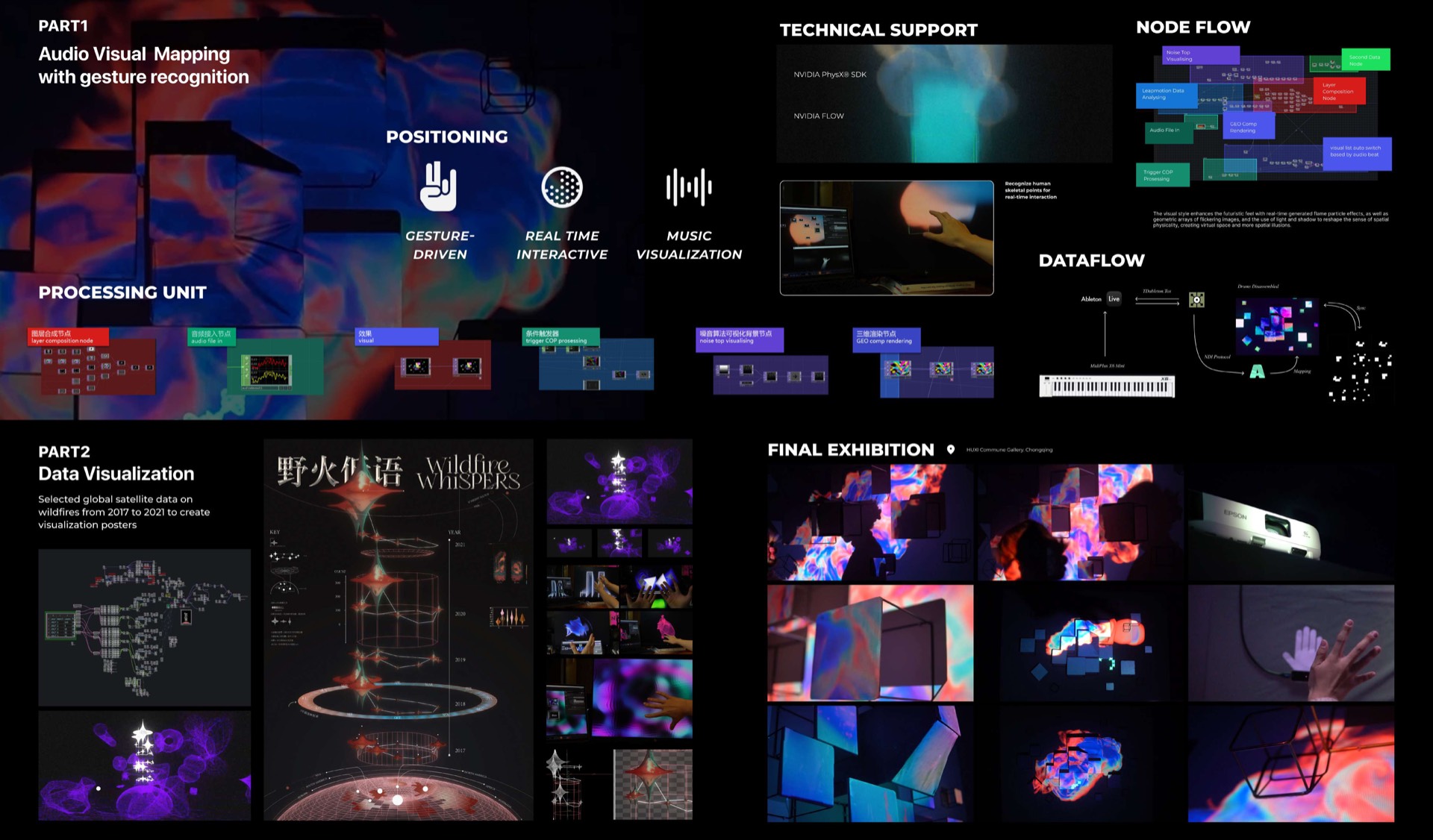
Hardware: a 3m × 2m geometric wall-mounted setup with responsive projections. Leap Motion sensor for gesture recognition. NVIDIA PhysX SDK + NVIDIA FLOW + a custom node-flow and dataflow pipeline.
Software: real-time gesture-driven particle effects and parametric arrays of flowing, leaf-like shapes; the visitor's hand sets a sense of spatial physicality and energetic flow. Music visualisation as a secondary input.
Visualisation series: selected global satellite data (2017 to 2021) → starburst-tree posters where fire severity drives the visual cadence.
Results & Impact
Two design outputs:
- An immersive embodied installation translating wildfire intensity into gesture-driven audio-visual response.
- A data-visualisation poster series that holds up to scrutiny as both data work and as design objects.
Final exhibition at H.U.B Cherrytree Gallery, Chongqing.
Lessons Learned
Two carry-forwards:
- Embodied data is design, not data. The same dataset earns a thousand different feelings depending on what the body does to interact with it. The design contribution sits in the gesture-to-mapping function, not in the dataset.
- Speculative fiction earns the data its weight. Without the 'Whispering Wildfire' framing, the visualisations are pretty; with it, they have a story to live in.
What's Next
The pattern. pair satellite environmental data with a body-first input layer. is portable to deforestation, glacial retreat, ocean acidification. Each one needs its own gestural vocabulary, but the underlying technique transfers.
Continue exploring